
Recording from NCSC webinar: The Case for Peacemaking Court
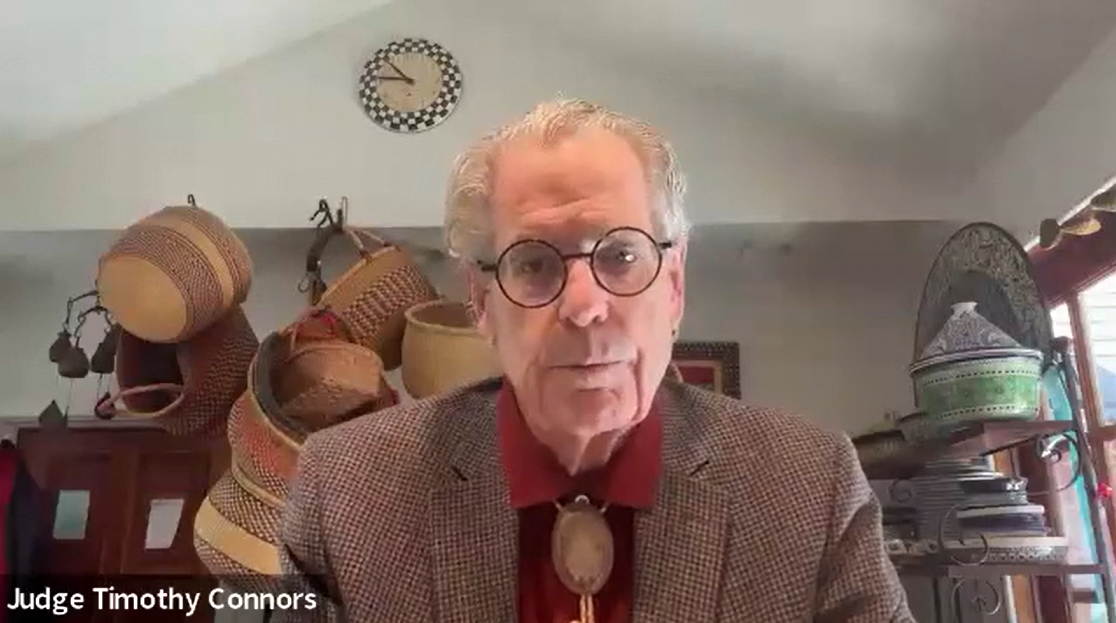
Judge Timothy Connors
Judge Timothy Connors share his expertise. He is also part of the Indigenous Peacemaking Initiative's Advisory Circle.
The National Center for State Courts recently sponsored a webinar on peacemaking courts in Michigan, featuring the story of how the peacemaking court developed in the Washtenaw County State Court in Ann Arbor, and discussion of the Peacemaking Court at the Little River Band of Ottawa Indians in Manistee. Guests included long term friends of NARF’s IPI. It’s a program worth viewing, and there is how the NCSC billed it:
“Peacemaking courts represent a powerful shift in how we think about justice — moving beyond purely punitive systems toward approaches that emphasize healing, accountability, community engagement, and restoration of relationships.
Rooted in Indigenous traditions and adapted within modern justice systems, peacemaking offers a meaningful way to address harm while strengthening individuals and communities.
Join the CCJ/COSCA Tribal Relations Committee and our panelists to explore:
- What peacemaking courts are and how they function
- The values and principles that guide this work
- Practical examples and lessons learned from implementation
- Overview of Michigan’s Tribal-State-Federal Judicial Forum
- Opportunities and challenges in implementing peacemaking approaches
Moderator:
- Abby Kuschel, principal court management consultant, NCSC
Panelists:
- Chief Justice Megan Cavanagh, Michigan Supreme Court
- Judge Timothy Connors (Ret.), 22nd Circuit Court, Washtenaw County, Michigan
Chief Judge Angela Sherigan, Little River Band of Ottawa Indians, Michigan